Sustainable Packaging for Perfume: Where the Real Trade-offs Sit
Most packaging sustainability decisions in fragrance are trade-offs, not wins. A refill reduces glass but adds a second container and a second filling operation; lightweighting saves material but can thin the wall where the customer forms a first impression. The useful question is not which option sounds greenest, but which impact you are actually trying to reduce and what the change costs elsewhere in the project.
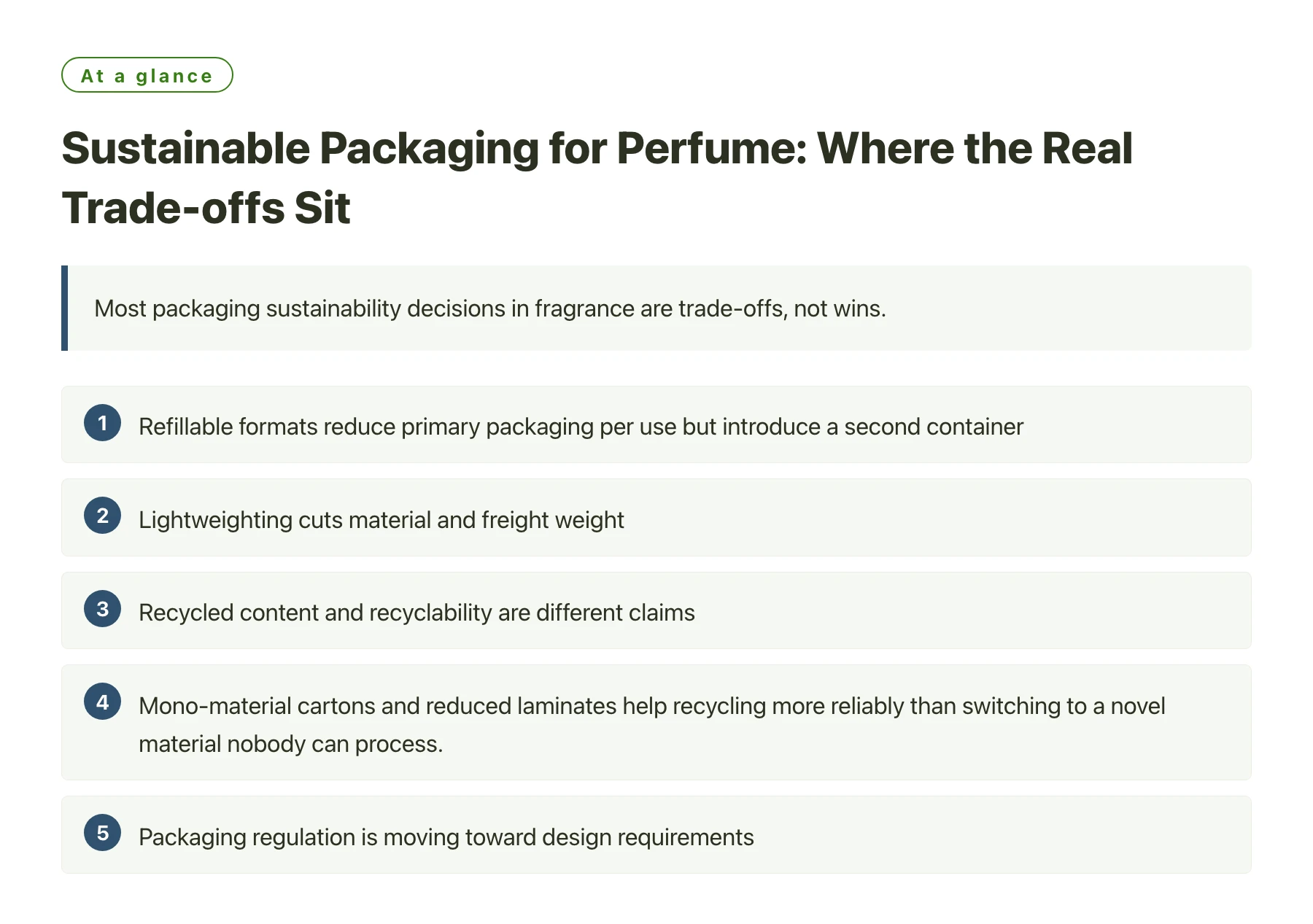
Key takeaways
- Refillable formats reduce primary packaging per use but introduce a second container, a second filling run and new leakage risks.
- Lightweighting cuts material and freight weight, and it also changes how a bottle feels in the hand at the shelf.
- Recycled content and recyclability are different claims, and both depend on what collection systems actually accept.
- Mono-material cartons and reduced laminates help recycling more reliably than switching to a novel material nobody can process.
- Packaging regulation is moving toward design requirements, so choices made now may be assessed against rules that are still being phased in.
Fragrance packaging is a small share of a product's total impact by weight and a large share of how the product is judged. That combination makes it an awkward place for simple decisions.
A brand can reduce glass, remove a laminate, switch to recycled board or introduce a refill — and each of those moves shifts cost, lead time and risk somewhere else in the project.
This article sets out the main options, what each one genuinely improves, and the questions worth settling before the tooling is cut.
Start by naming the impact you want to reduce
Sustainability in packaging is not a single objective. Material weight, carbon intensity, recycled content, recyclability at end of life and transport efficiency all point in different directions depending on the product.
A brand that has not chosen which of those matters most will end up optimising whichever one the supplier happens to be good at.
Weight and carbon are related, not identical
Glass is heavy, and weight costs fuel in freight. Halving the glass in a bottle reduces transport emissions, yet the melting energy per kilogram of glass is largely unchanged, so the material footprint improves less than the transport figure suggests.
This is why lightweighting is genuinely useful and rarely sufficient on its own. It is one lever, and it is easiest to apply to secondary packaging, where the customer has no tactile expectation.
End-of-life recyclability depends on infrastructure
A material is only recyclable if the local collection and sorting system can process it and there is a market for the output. That varies enormously between markets, which is why a claim that is accurate in one country can be misleading in another.
Design guidance from industry groups tends to converge on the same practical advice: fewer materials, easier separation, and components that do not contaminate a recycling stream [1].
Regulation is shifting toward design requirements
European packaging rules are moving beyond waste targets to address how packaging is designed, including requirements on recyclability and on the use of recycled content over a phased timeline [2].
For a fragrance brand, the practical implication is that a packaging choice made today may be assessed against requirements that are still being introduced. Designing for disassembly now avoids a redesign later.
Five options, and what each one actually changes
| Option | What it improves | What it costs you | Question to settle first |
|---|---|---|---|
| Refillable bottle with a refill pack | Reduces primary packaging per use over the life of the outer bottle | A second container, a second filling operation and a new leak risk at the refill interface | Will customers actually refill, and can the refill be filled on existing lines? |
| Lightweighted glass | Less material and lower freight weight per unit | Thinner walls change the feel on shelf and may affect impact resistance in transit | Does the bottle still pass your drop and transport tests at the reduced wall thickness? |
| Recycled glass content | Reduces demand for virgin raw material in the melt | Availability and colour consistency vary, and some decorative finishes are harder to achieve | Can the glassworks hold a consistent colour across production runs? |
| Mono-material folding carton | Simpler to sort and recycle than a laminated or foil-stamped board | Fewer premium finishing options, so the carton may read as plainer on shelf | Which decorative effects are non-negotiable for the brand? |
| Refill pouch or concentrate | Very low material per use and low transport weight | Needs consumer education and a robust closure, and the format may not fit the brand's positioning | Does the format suit the channel where the product will actually be sold? |
The fourth column is where most projects stall. A packaging change is only viable if the material, the filling line and the consumer behaviour all support it at the same time.
Be careful with the words on the pack. Recyclable, recycled, refillable and compostable are all defined terms in several markets, and the definitions include conditions that a marketing team may not have read. A carton described as recyclable in one country may not meet the threshold in another. Get the exact wording reviewed by whoever handles your regulatory file, and keep the supporting evidence on record.
Where the cost actually lands
Sustainable packaging tends to shift cost rather than remove it. Understanding where it moves makes the internal business case much easier to write.
Tooling and minimum order quantities
A new bottle shape means a new mould, and a new mould means a minimum run that has to absorb it. Reusing an existing mould with a lighter wall is often the cheaper route to a lower-impact bottle.
Refill formats add a second set of components, so the tooling conversation doubles even when the outer bottle is unchanged.
Filling line time
A refill pack is a second product to fill, label and pack. That is a second pass through the line, and on a high-volume product the labour and line time can outweigh the material saved.
Brands evaluating a refill should ask for a quotation on both the original and the refill at the same volume, which is the only way the comparison becomes real. Asking a manufacturer such as Xuelei Perfume to price the two side by side is usually the fastest way to get there. Where the refill is a concentrate rather than a full bottle, the arithmetic usually improves, because the transport weight falls sharply.
Freight and storage
Lighter secondary packaging reduces freight cost and warehouse volume, and it does so from the first shipment rather than after a customer refills anything. For brands shipping across regions, this is often the fastest measurable saving.
It is also the least visible to the consumer, which makes it an easy change to approve.
A practical sequence for a packaging review
- List the components and their materialsBottle, pump, collar, cap, label, carton, insert and shipper each have their own material story and their own disposal path.
- Mark what can be separated by handComponents that come apart easily are more likely to be sorted correctly, and that is a design decision rather than a materials one.
- Choose one primary objectivePick weight, recycled content or recyclability as the headline goal, and accept that the others will be secondary.
- Price the change at real volumeAsk for unit cost at your actual order quantity, including any new tooling, so the comparison is not built on launch pricing.
- Test the pack before committingDrop tests, transport trials and a shelf mock-up will reveal whether the lighter or simpler version still performs.
- Check the claims against the marketConfirm that the wording you intend to print is supportable in every country where the product will be sold.
Sources
- Sustainable Packaging Coalition —— A membership organisation working on more sustainable packaging design, publishing material and recyclability guidance.
- European Commission: Packaging Waste and the PPWR —— EU rules on packaging and packaging waste, including the Packaging and Packaging Waste Regulation requirements on recyclability and design.
Frequently asked questions
Are refillable perfume bottles actually better for the environment?
They reduce primary packaging per use, which is a real benefit, but they add a second container and a second filling operation. The net effect depends on how many times customers refill and how the refill is packaged. A refill that is rarely used can be worse than a single well-designed bottle.
Is recycled glass the same quality as virgin glass?
It can be, but colour consistency and availability vary between suppliers. Some decorative finishes and very clear glass are harder to achieve with high recycled content. Ask the glassworks to confirm how it holds colour across production runs before you commit to a finish.
What does mono-material packaging mean for a perfume carton?
It means the carton avoids mixed materials such as plastic lamination, foil stamping or a magnetic closure bonded to board, so it can be sorted as one stream. The trade-off is a plainer finish, since those effects are what usually make a carton feel premium.
Do I need to change packaging because of European rules?
European packaging policy is moving toward design requirements covering recyclability and recycled content over a phased timeline. The specifics depend on the final rules and your product category, so the safe approach is to design for easy separation now and keep evidence for any claim you print.
Which packaging change gives the fastest return?
Usually weight reduction in secondary packaging and shipping materials. It lowers freight cost and storage volume from the first shipment, requires no consumer behaviour change, and does not touch the parts of the pack the customer handles.