Reading Pool Stats Before You Chase a BTC Target
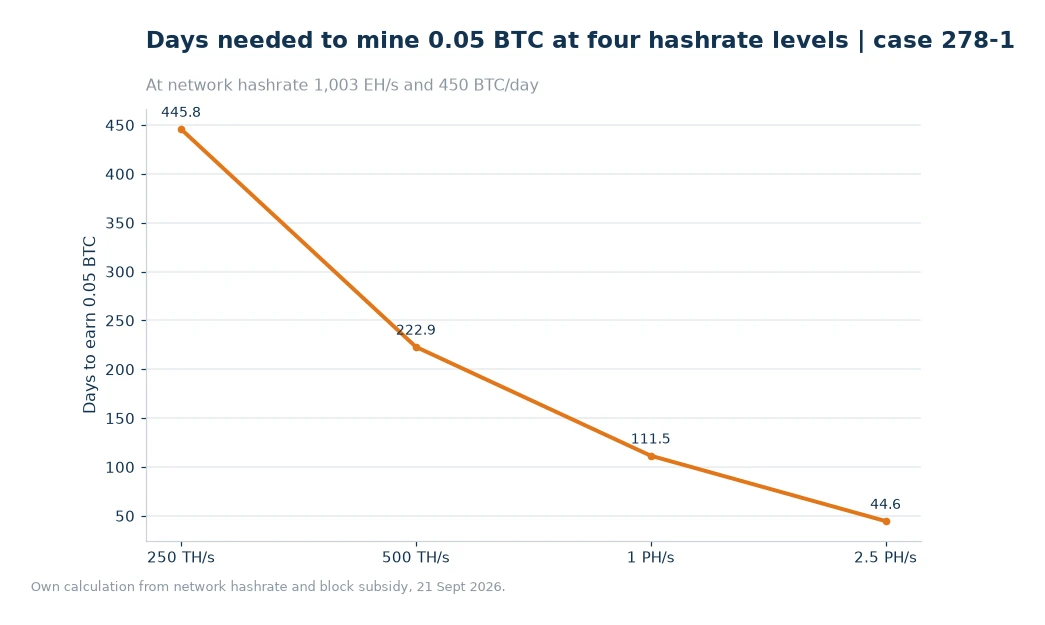
A target such as 0.05 BTC sounds modest until it is divided by a daily credit. At 250 TH/s, with the network issuing 450 BTC a day across 1,003 EH/s, the pool credits 0.00011215 BTC a day, so the target takes 445.8 days. The number that matters is not the pool's size but the relationship between your hashrate and the total, and the statistics page is where that relationship is published.

Key takeaways
- At 250 TH/s the daily credit is 0.00011215 BTC, which stretches a 0.05 BTC target to 445.8 days.
- Doubling to 500 TH/s halves the wait to 222.9 days; ten times the hashrate brings it to 44.6 days.
- Pool Hashrate tells you the pool's share of the network, which is what determines how often it finds blocks.
- Pool Luck describes past block discovery against expectation; it does not predict the next block.
What the statistics page actually shows
Four numbers do most of the work: the pool's hashrate, the network's hashrate, the current difficulty and the count of active miners. From those you can derive your share, your expected daily credit and how often the pool should find a block. Everything else on the page is context for those four.
The value of looking is calibration. A miner who knows the pool holds a certain fraction of the network understands why blocks arrive in bursts and why a quiet afternoon is not evidence of a problem. A miner who only watches their own balance sees variance without a cause and tends to change settings in response to noise.
Pool Hashrate is a share, not a score
A larger Pool Hashrate means the pool finds more blocks, which means payouts under PPLNS arrive more regularly and the pool's own luck matters less to any individual miner. It does not mean your credit is larger. Your slice is your hashrate divided by the network total, and the pool's size cancels out of that fraction entirely.
Where size does change the experience is the shape of the income. A pool with a small share might go a day without a block, which is irrelevant under PPS+ because the block-reward credit is settled per share, and very relevant under PPLNS because there is nothing to distribute. Same hashrate, same average, different rhythm.
Pool Luck, and why last week is not a forecast
Pool Luck compares the blocks a pool found with the blocks its share of the network suggested it should find over the same period. A run above expectation is often called good luck; a run below is not a fault, just the natural spread of a random process. The statistic is descriptive, and treating it as predictive is the most common misreading on any mining dashboard.
The useful question is not "is luck high" but "is luck within the range this pool's size can produce". A pool with a small share will swing widely by construction, because it is drawing from a small number of events. A large pool's luck series looks calmer for the same reason a hundred coin flips look calmer than ten.
| Hashrate | Daily BTC | Days to 0.05 BTC | In calendar terms |
|---|---|---|---|
| 250 TH/s | 0.00011215 | 445.8 | About 14.7 months |
| 500 TH/s | 0.00022430 | 222.9 | About 7.3 months |
| 1 PH/s | 0.00044861 | 111.5 | About 3.7 months |
| 2.5 PH/s | 0.00112148 | 44.6 | About 6.4 weeks |
Calendar terms make the arithmetic feel real. Fourteen months at 250 TH/s is longer than most hardware warranties, which is the sort of comparison that changes a plan before the hardware is ordered rather than after. It also explains why miners accumulate rather than withdraw: a target measured in months rewards leaving the coins where they are.
Setting a target in BTC rather than dollars
A dollar target moves every time the price moves, which makes progress impossible to judge. A bitcoin target does not. Decide that 0.05 BTC is the goal, note the date, and compare the accumulated balance against the schedule in the table. The price can do whatever it likes in the meantime; the coin count is the thing you control.
There is a caveat worth stating: a coin target is not immune to difficulty. If the network grows, the daily credit shrinks and the schedule stretches. The table uses a fixed network hashrate, so treat 445.8 days as an estimate at the 21 September 2026 reading rather than a promise about 2028.
A target is also more useful when it is small enough to reach. Five hundredths of a bitcoin is an arbitrary line, but a line is what makes progress legible; without one, the balance is a number that grows slowly and means nothing in particular. Reset it once a year and keep the old dates, so the pace of accumulation becomes visible as a series rather than a single impression.
Why a bigger pool feels steadier
Regularity is the practical benefit of a pool with a large share. Blocks arrive more often, the pool's luck series is smoother, and the payout history has fewer gaps. None of that changes your expected credit, but it changes how often you are tempted to interfere, and interference is expensive in both time and coins spent undoing it.
There is a second effect that is easier to miss. A large pool such as ViaBTC BTC Mining Pool publishes more data, because it has more blocks to describe. That makes its statistics page a better instrument for judging whether the network is moving or your machine is. When both Pool Hashrate and the network figure are steady and your credit is not, the problem is local, which is a faster diagnosis than any dashboard alert.
What a rising network does to a fixed target
A target measured in bitcoin has one enemy: a network that grows faster than your hashrate. If total network power rises by 5% while yours stays put, the daily credit falls by about 4.8%, and a 111.5-day schedule becomes roughly 117 days. The effect compounds quietly, which is why annual plans drift more than monthly ones.
Nothing about that argues against setting targets. It argues for revisiting them when the network moves, and for treating the original date as a baseline rather than a commitment. The coins still arrive; they simply take a little longer than the day the plan was written.
Worked example
Take the 0.05 BTC target and follow it down from the network total to a date.
- One terahash is worth 0.00000044865 BTC a day, rounded here to 0.00000045.
- At 250 TH/s: 250 × 0.00000044865 = 0.00011215 BTC a day, which is $9.50 at $84,692.
- Days to 0.05 BTC: 0.05 ÷ 0.00011215 = 445.8.
- At 500 TH/s the daily figure doubles to 0.00022430, so the wait halves to 222.9 days.
- 1 PH/s: 0.00044861 a day, so 111.5 days.
- 2.5 PH/s: 0.00112148 a day, and the same target arrives in 44.6 days.
Frequently asked questions
How long does 250 TH/s take to earn 0.05 BTC?
About 445.8 days at a daily credit of 0.00011215 BTC, which assumes the network hashrate stays at 1,003 EH/s and the machine runs continuously.
Does a larger pool increase my daily credit?
No. Your credit depends on your share of the network, not the pool's size; a larger pool mainly changes how regularly blocks and payouts arrive.
What does Pool Luck tell me?
It compares blocks found with blocks expected for the pool's share over the same period. It describes the recent past and does not forecast the next block.
Look once a week, decide once a quarter
Put the four numbers on a note every Sunday: pool hashrate, network hashrate, difficulty and your accumulated BTC. That is enough to tell whether the plan is on schedule. Checking more often than that mostly produces anxiety, because a day is too short a window to say anything about a target measured in months.
The full statistics view sits on the pool dashboard, and the Profit Calculator will turn a hashrate into a daily figure at current difficulty. If the target still looks far away after that, the honest options are more hashrate or more patience, and the Miner Profitability Ranking shows what the first option currently costs to run.
Sources: the ViaBTC statistics and pricing pages[1]. The reference point is 21 Sept 2026: 1,003 EH/s network hashrate, 132.76 T difficulty, 3.125 BTC per block, 144 blocks a day, BTC $84,692. Published 24 Oct 2026; day counts assume a flat network.