How Does Commercial Plywood Compare With Particle Board?
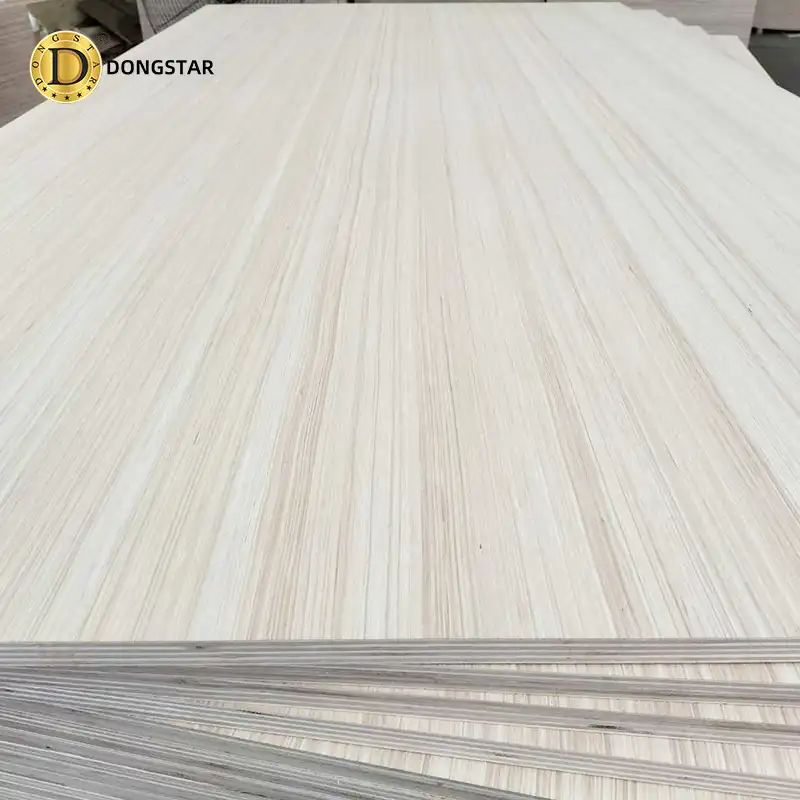
Commercial plywood generally provides higher bending strength, stronger screw retention, better edge strength, and better tolerance of occasional moisture than standard particle board. Particle board offers a flatter surface and lower material cost for dry indoor furniture. An 18 mm P2 particle board under EN 312 typically requires bending strength around 11 N/mm² and modulus of elasticity around 1,800 N/mm², while commercial plywood products can commonly reach much higher bending figures depending on veneer species and construction. For cabinets, shelving, furniture frames, and repeated fastening, plywood usually handles mechanical stress better; particle board remains practical for laminated panels, wardrobes, desks, and economical mass-produced furniture.
The difference starts inside the panel. Commercial plywood is built from continuous wood veneers, normally arranged with neighboring grain directions at roughly 90 degrees. A 15 mm or 18 mm sheet may contain several cross-laminated plies, so stress can pass through long wood fibers rather than through small bonded particles. Commercial plywood densities commonly sit around 500–700 kg/m³, depending on species, veneer thickness, glue content, and pressing conditions.
Particle board uses wood particles mixed with resin and pressed into a dense mat. Many furniture-grade boards use finer particles near the faces and larger particles in the center. Under EN 312:2010, P2 board is intended for interior fitments, including furniture, in dry conditions. For thicknesses from 13 to 20 mm, the standard specifies bending strength of about 11 N/mm², bending modulus around 1,800 N/mm², and internal bond strength around 0.35 N/mm².
That internal construction affects long shelves before it affects appearance. A plywood shelf can distribute bending stress through multiple veneer directions, while particle board relies on compressed particles and resin bonds. If two 18 mm shelves have the same 900 mm unsupported span, their actual deflection can differ considerably because stiffness depends on modulus, density, panel structure, load position, and support conditions rather than thickness alone.
Furniture designers can reduce particle-board deflection by shortening spans, increasing thickness, adding a front rail, or installing another support. Moving from an 18 mm panel to a thicker panel increases section stiffness substantially because bending stiffness rises strongly with panel depth. A plywood panel can therefore be selected at a lower thickness in some applications, although engineering data from the specific supplier should be checked before changing dimensions.
Fasteners show another practical difference. Plywood screws pass through continuous veneer fibers, while particle-board screws grip compressed particles. The USDA Wood Handbook published in its revised 2021 edition notes that screw withdrawal behavior in particle board is strongly related to board density, screw dimensions, penetration depth, and whether the screw enters the face or edge. Its particle-board equations also distinguish face and edge withdrawal rather than treating both positions as equivalent.
Repeated assembly makes the difference easier to notice. A hinge fixed into particle board can perform well when the correct pilot hole, screw diameter, insertion torque, and hinge pattern are used, but repeated removal can enlarge the particle structure around the threads. Confirmat screws, dowels, threaded inserts, and purpose-made furniture connectors are often used to improve joint performance. Plywood is generally more tolerant when a cabinet, bed frame, shop fitting, or transport case will be assembled more than once.
Moisture changes the comparison again. Ordinary particle board can absorb water rapidly through cut edges and drilled holes. Once the particles swell, drying does not always return the board to its original thickness. EN 312 includes separate classifications for different service conditions; P3, for example, covers non-load-bearing boards used in humid conditions rather than treating all particle board as suitable for the same environment.
For 13–20 mm P3 board, EN 312:2010 lists bending strength around 14 N/mm², modulus around 1,950 N/mm², internal bond around 0.45 N/mm², and 24-hour thickness swelling around 14%. Those figures are different from P2 requirements, so an importer comparing quotations should ask for the exact board class rather than accepting the phrase “moisture resistant” without a test specification.
Plywood also needs an appropriate bond class. A plywood face may look unchanged while the glue line is unsuitable for extended wet exposure. APA guidance distinguishes Exterior plywood from Exposure 1: Exterior panels are made for repeated wetting and drying or long-term weather exposure, while Exposure 1 panels are intended for limited moisture exposure during construction or similar conditions. The current U.S. PS 1-22 structural plywood standard was revised in 2023 and covers veneer grading, adhesive bonds, construction, dimensions, tolerances, moisture content, and quality control.
Surface quality moves the advantage toward particle board in some furniture lines. Its fine outer particles form an even substrate for melamine paper, HPL, veneer, and other decorative surfaces. Large automated cabinet plants can cut hundreds of identical parts from calibrated panels where a consistent face and predictable thickness matter more than visible natural grain.
Plywood has more natural variation because the outer surface is wood veneer. Face grades can include color differences, repaired defects, patches, grain changes, or permitted knots. Better face grades can be used with transparent coatings or decorative veneer, while utility grades can sit below laminate. A buyer ordering 10,000 sheets should therefore specify face grade, allowable repairs, sanding, thickness tolerance, and accepted reference samples instead of judging one showroom sheet.
| Property | Commercial plywood | Particle board |
|---|---|---|
| Internal structure | Cross-laminated veneers | Resin-bonded wood particles |
| Typical density range | About 500–700 kg/m³ | Often about 600–800 kg/m³ |
| Screw holding | Generally stronger, especially for repeated fastening | Suitable with correct screws and connectors |
| Edge strength | Higher in comparable furniture applications | More sensitive to edge damage |
| Surface uniformity | Depends on veneer grade | Very uniform |
| Moisture response | Depends on bond class and construction | Standard grades can swell strongly at exposed edges |
| Long shelving spans | Usually more suitable | Often needs thicker panels or added support |
| Decorative lamination | Suitable | Very suitable |
| Material price | Usually higher | Usually lower |
Weight also deserves calculation rather than assumption. Particle board is sometimes described as the lighter economical panel, yet its compressed structure can make it as heavy as or heavier than some plywood constructions. An 18 mm panel at 650 kg/m³ contains about 11.7 kg of material per square meter; at 550 kg/m³, the figure is about 9.9 kg/m², a difference of roughly 18% before packaging, hardware, or surface materials are added.
Across a 1220 × 2440 mm sheet, that density difference produces several kilograms of extra panel weight. Across a full container or a furniture program using several thousand sheets, it affects handling, pallet design, cabinet mounting hardware, freight planning, and finished-product weight. Density alone does not show strength, however; a denser particle board should not automatically be treated as structurally equivalent to plywood with continuous veneers.
Machining also changes total production cost. Particle board gives consistent CNC routing and drilling when density and surface quality are controlled, but most visible edges need PVC, ABS, veneer, or another edge treatment. An 18 mm wardrobe side may therefore require cutting, drilling, edge banding, trimming, and cleaning before assembly.
Plywood can also require edge finishing, yet exposed plywood edges may be acceptable in some furniture styles. Cutting quality depends on face veneer, blade geometry, feed speed, and scoring equipment. For factories producing 5,000 or 20,000 identical cabinets, a small difference in machining time per panel can affect labor and equipment capacity more than a modest difference in raw sheet price.
Indoor emissions should be checked separately from mechanical performance. European wood-based panel specifications have historically used formaldehyde classes under EN 13986; E1 has been associated with a chamber concentration below 0.124 mg/m³ under EN 717-1. Resin chemistry, test method, finished surface, exposed edges, and destination-market rules all need to be confirmed rather than assuming that plywood automatically emits less than particle board.
For purchasing, the useful comparison is therefore a technical specification rather than two product names. A quotation should state thickness and tolerance, dimensions, density range, moisture content, face and back grade, core construction, adhesive or bond class, emission classification, mechanical test requirements, surface treatment, packaging method, and applicable standard. A difference of only 0.5 mm in nominal 18 mm production can affect CNC machining, hinge installation, grooves, and assembled cabinet dimensions.
Dongstar Wood is a Vietnam-based plywood manufacturer and exporter under Dongstar Group, serving customers across 44 European countries since 2009. We specialize in commercial plywood, film faced plywood, construction plywood, birch plywood, furniture plywood, and customized plywood solutions.
Backed by CE 2+, FSC®, EUDR, DOP, and SEDEX (BSCI) certifications, we meet European standards for quality, sustainability, and compliance. With over 15 years of manufacturing and export experience, we support importers, distributors, furniture manufacturers, and construction companies with reliable plywood supply and OEM/ODM solutions.
Construction buyers may also compare commercial plywood with products made for concrete formwork. Black Film Faced Plywood uses a film-covered plywood structure rather than a particle-board core, so its intended use, surface treatment, bond requirements, edge sealing, and reuse conditions differ from ordinary furniture panels. A 12 mm, 15 mm, or 18 mm formwork sheet should therefore be specified according to the concrete job and supplier data rather than substituted by indoor particle board.
Purchase price still matters, but it should be calculated together with processing. Particle board may cost less per cubic meter, yet furniture production can require additional edge banding, connector hardware, shelf supports, thicker sections, or replacement of moisture-damaged parts. Plywood costs more in many markets but can reduce material thickness or hardware requirements in some assemblies.
For a dry, melamine-faced office cabinet expected to stay indoors for 10 or 15 years, properly specified particle board can provide suitable service at lower material cost. For a repeatedly moved cabinet, a 900–1,200 mm loaded shelf, furniture with screws close to panel edges, transport packaging, or parts exposed to intermittent moisture, commercial plywood generally offers a larger mechanical margin. The final specification should be based on measured panel properties and the actual service conditions rather than price per sheet alone.